Lead Scotland’s Manifesto 2026: A Right to Learn
We want a fair society where disabled people and carers have an equal opportunity to learn, participate and achieve their potential.
As the Scottish Parliament elections approach on Thursday 7th May 2026, we have decided to publish our own manifesto for change: A Right to Learn. We consulted staff and stakeholders online, in person and via video conferencing to find out what changes they wanted to see over the course of the next parliamentary term. We asked what they wanted candidates to commit to and support in promoting fairer access to post-school learning for disabled people and carers.
Six key priorities emerged from the feedback:
1. Ensure everyone can access digital services and the support to use them.
2. Expand flexible, accessible learning that works around people’s lives.
3. Fix broken transitions for disabled people from school to college, work and adult life.
4. Tackle loneliness by investing in community connection and support.
5. Provide fair, long terms funding for essential support services people rely on.
6. Improve access to justice for disabled students with clear, fair routes to put things right.
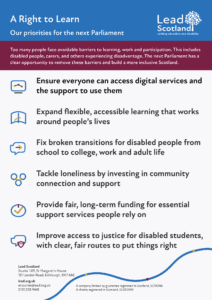
(Image shows a one page decorative document stating, ‘Too many people face avoidable barriers to learning, work and participation. This includes disabled people, carers, and others experiencing disadvantage. The next Parliament has a clear opportunity to remove these barriers and build a more inclusive Scotland.’ It then lists the six priorities with an icon next to each priority)
Click on the links below to read our full manifesto, why it matters and what you told us.
Lead Scotland’s Manifesto: A Right to learn (with Foreword)
Lead Scotland Manifesto Text only
You can also click the below link to access an email template to use to contact your local candidates to ask them to stand up for disabled people and commit to these changes. In the Scottish Parliament, 8 MSP’s represent you – one constituency MSP and seven regional MSPs. You can find all the candidates for your local area by clicking on this ‘Who can I vote for’ link and typing in your postcode.
Email template to share with candidates
If candidates come knocking at your door to canvas for your vote or you attend a hustings event, you may want to consider asking the following questions:
- Will you guarantee disabled people affordable access to devices, internet, and the choice to use public services offline?
- How will you ensure post‑school learning is genuinely accessible, flexible, and properly supported for disabled learners?
- What will you do to fix broken transitions for young disabled people leaving school and ensure no one is left without options or support?
- Will you invest in community‑based adult learning and local support to tackle loneliness and isolation among disabled adults?
- Will you commit to multi‑year funding for learning and support services so disabled people aren’t hit by sudden closures?
- How will you ensure disabled students can realistically enforce their rights when colleges or universities fail to provide support?